


How to Choose a House Facade in 2026
- Home Designs

The short version
- Your façade is the front face of your home. It sets the style for everything behind it.
- Pick the architectural style first, then check what your council and estate will allow.
- Brick, fibre cement, timber, render and steel all look different and wear differently. There's a comparison table below.
- If your block is bushfire prone, your material choices narrow. Check before you fall in love with timber.
- Three colours is the usual recipe: a main colour, an accent and a trim.
First impressions count, right? That's why choosing a house façade for your new home is important. And fun!
Let's look at what a façade is, why it's a key part of any home's design and then jump into how to choose the best look for you.
What is a house façade (and how do I pronounce this word)?
A façade is the front exterior part of a building. Whether a cathedral, a town hall, a hotel or your dream home, the façade is the appearance that greets you on arrival.
The word has come into English from the French and it is often still written in English with the little squiggle under the c: façade. This word came from the Latin word 'faccia', which means face. So, you can think of a façade as the 'frontage' or the 'face' of your house.
FUN FACT: For those interested in words and language, note that 'façade' has a different word origin than 'fascia' which is also used in building for the outer view under a roof edge, which originated from the Latin word fascis, meaning a strap or band.
How do you pronounce this tricky word 'façade'? The 'c' becomes an 's' sound so it's pronounced 'fasard'.
Why is it important to choose a façade as part of my home design?
Aside from providing a warm welcome home at the end of each day, your home's façade sets the tone for the rest of the house. It will help define the interior layout, design and décor.
It's also the part of the house everyone sees. Neighbours, visitors, and one day, buyers. People judge books by their cover, and they judge houses from the kerb, so a façade that's been thought through does a lot of the work for you.
There's a practical side too. Which way the front of your home faces, and how big the windows are, changes how warm the living areas get in winter and how hot they get in summer. According to the Australian Government's YourHome guide to orientation, north-facing walls and windows get more sun in winter than in summer because the sun sits lower in the sky, and standard eaves will let that winter sun in while shading the summer sun, with no effort from you. Worth keeping in mind when you're picking a design with a lot of glass on the front.
How can I choose the best façade for me?
When choosing a façade, you're aiming to create a picture that represents how you live.
There are many factors and ideas to consider when designing a façade for your home, including the architecture, the location, your preferred colours and materials, as well as features including lighting and landscaping.
Let's look at each of those in turn within contemporary house design in Australia:
1. Architectural style
Kick start your ideas about your home's appearance by familiarising yourself with the key features of different styles of architecture and what you like about them.
Do you prefer the boxy, modular shape of a modern design? Or the character and gabled roofline of a Hamptons style home? Perhaps your ideal look is clean and contemporary, or maybe you're most drawn to a heritage-inspired classic design?
Windows are a significant part of a façade style as well as impacting what it's like to live in the home, so consider the number and size of windows as well as any overlooking issues in relation to neighbouring properties.
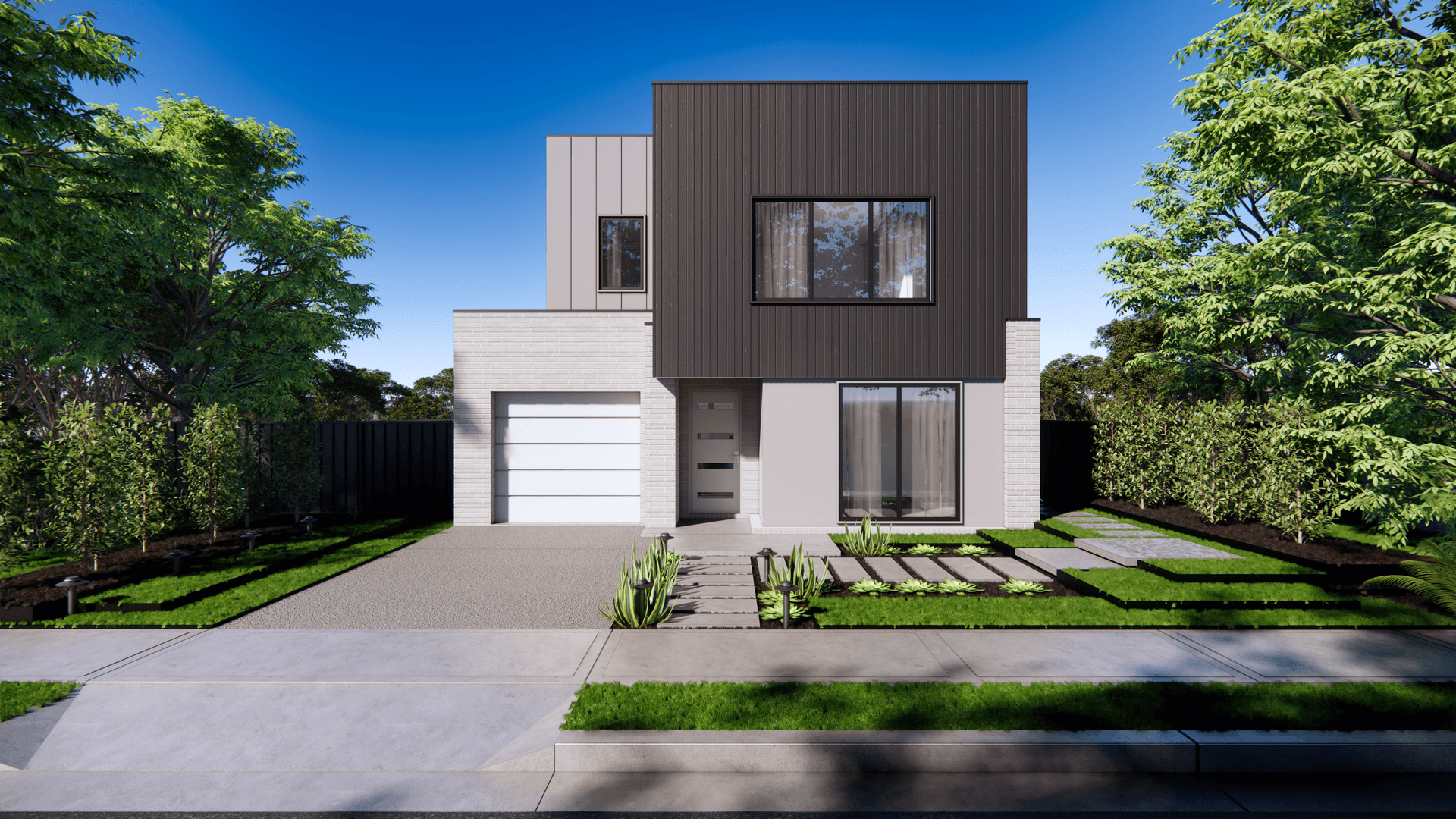
Rawson Homes has more than 60 one- and two-storey home designs, each with different façades to choose from, so deciding on the style that best suits your personal taste will help to narrow down your options from the outset.
2. Location
The location of your dream home may impact your choice of façade, either simply because you're keen for your home to blend with neighbours or because planning overlays restrict your options.
If you're building in an area with a lot of period houses, a modernist façade may look out of place in the streetscape. Maybe you're happy to be the owner of the different house that everyone's eyes are drawn to, or perhaps you'd prefer to fit in with the general neighbourhood vibe.
The local council may also have restrictions around overlays and neighbourhood character. That's why your first call should be to your local building and planning department to find out what you can and can't build.
One overlay worth checking early is bushfire. A lot of new estates on Sydney's fringe and around Canberra sit on land that's mapped as bush fire prone. If yours is, the NSW Rural Fire Service says you have a legal obligation to meet Planning for Bush Fire Protection 2019, and your home gets a Bushfire Attack Level (BAL) rating from BAL-LOW up to BAL-FZ. The higher the rating, the fewer materials you can use on the outside of the house. You can check your block on the NSW Planning Portal spatial viewer in a couple of minutes, and it's a much better time to find out than after you've settled on timber cladding.
3. Materials selection
Once you have chosen a design for the façade, it's time to decide which materials will work best to bring it to life.
Some architectural styles call for specific materials. For example, the Hamptons look is centred on our love of the weatherboard look, which evokes a relaxed coastal lifestyle.
That's why James Hardie's Linea™ Weatherboards are the perfect finishing touch for both the classic or contemporary Hamptons home. Made from durable fibre cement, James Hardie weatherboards not only deliver a luxurious look, but one that resists warping, termites and damage from moisture.
Bricks are a hardworking, versatile and affordable building material that will add depth and complexity. They're also still the most common cladding on Australian homes, according to YourHome. Render, another façade material option, is another low-maintenance option that pairs well with timber or stone as an accent.
Timber cladding is particularly popular for Hamptons and contemporary-style homes and can work in suburbs with a strong heritage character. Other materials like stone and glass can also be used to add a creative touch to a façade.
Looks are only half of it, though. Each material ages differently, wants a different amount of upkeep from you, and copes differently with bushfire. Here's how the main options stack up, using the Australian Government's YourHome cladding guide as the reference.
| Material | How it wears | Upkeep | Bushfire rating (BAL) |
|---|---|---|---|
| Brick | Highly durable on well-designed footings | Lowest of the lot if it's left unpainted and unrendered | Non-combustible, suits high BAL zones |
| Fibre cement weatherboard (e.g. James Hardie) | Highly durable and holds its shape | Low, but it needs painting or sealing to stay waterproof | Up to BAL-FZ |
| Timber weatherboard | Moderate to high, depending on the species and how well you look after it | High, unless you leave it raw and let it grey off | Hardwood up to BAL-29 |
| Render | Long lasting when installed properly | Minimal, with the colour coat generally good for 15 years or more | Depends on what's underneath |
| Steel (e.g. Colorbond) | Galvanised steel can last more than 100 years on a building | Very low | Up to BAL-FZ |
So if your block comes back as BAL-40 or Flame Zone, brick, fibre cement and steel are your friends. If it's BAL-LOW, the whole menu is open. The point is to know your rating before you settle on a look, because it's a lot easier to design around it than to redesign after the fact.
There's also the roof to consider. Rawson Homes offers CSR Monier Horizon concrete tiles or Colorbond metal roofing in a range of colours and profiles.
Consider how materials will tie in with your ideal driveway, fencing and landscaping. All these elements should work together to create a harmonious picture of the exterior of your home.
Visit different display homes to understand their construction. Or take a drive around your neighbourhood for inspiration, but don't be afraid to try something different and make your façade stand out from the crowd.
4. Colour scheme
As you consider colour options, make sure you start with the natural textures of the materials you've selected, such as timber, stone and brick.
In most cases, a home's exterior colour scheme should include three shades:
- Firstly, a dominant field colour, which will be the main colour visible.
- Secondly, an accent colour provides contrast or depth.
- Thirdly, a trim colour is used for guttering as well as around windows and for door frames.
You could stick with neutrals from the same colour family for a relaxed and more muted colour scheme. Or you can opt for a bold contrast, such as a dominant charcoal paired with a strong accent colour and a white trim to ensure your façade pops.
Consider injecting a bit of personality with a brightly coloured front door, such as in canary yellow or burgundy red. Think of it as jewellery for your house as it can be a little flashier than the rest of the façade.
Choosing a colour scheme can leave even the most seasoned home builders feeling overwhelmed, which is why Rawson Homes has a team of colour consultants who are experts in eggshell, ecru, emerald, eucalyptus and every shade in between.
5. Lighting and landscaping
While not technically part of the façade of the house, your chosen lighting and landscaping will complete the exterior of your home and help you achieve that all-important curb side appeal.
Consider adding soft, ambient lights to feature walls and pillars. Pathways can be brightened and highlighted with the addition of stylish bollard or deck lighting.
Add life and colour in front of and around your home's façade using plants and shrubs. When it comes to choosing a landscape design for your front yard, go for a mix of grass, plants, tiles, rocks or pebbles to give your garden sophistication.
A key part of plant selection is the issue of maintenance. Just how much time do you want to spend in your garden? If you love to while away your weekends getting your hands dirty with a spot of pruning, watering and composting, then you can fill your gardens with plants that need a bit of TLC.
By contrast, if you often find yourself too busy on the weekends to even think about picking up a hose, let alone search out the ideal fertiliser for your plants, then stick to species, like succulents or natives, that don't need much attention.
We would love to help you find your ideal façade! Check out our home designs or call 1300 223 345.


